What Are Cannabis Tinctures? A Complete Guide for Beginners

by Bowdega Cannabis | October 14, 2026
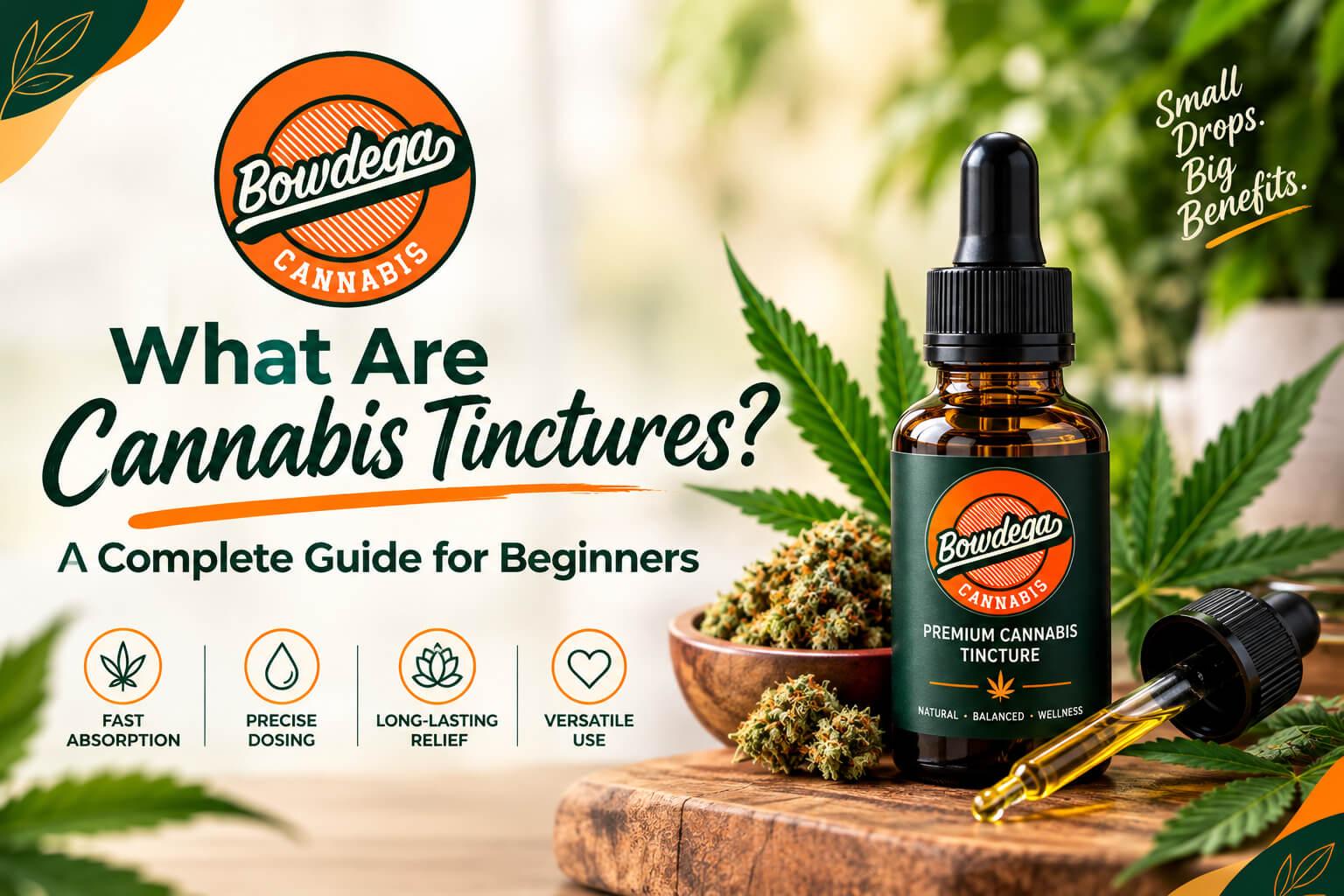
Cannabis tinctures offer a smoke-free way to consume cannabis. They usually come in small bottles with droppers for measuring liquid doses. However, their ingredients, strength, and effects can vary.
Therefore, beginners should understand how tinctures work before choosing a product. This guide explains tincture types, dosage labels, onset time, and safety tips to help you make informed decisions.
Understanding Cannabis Tinctures and How They Work
Cannabis tinctures are liquid products that contain compounds extracted from the cannabis plant. These compounds may include tetrahydrocannabinol (THC), cannabidiol (CBD), or both.
Manufacturers combine the extract with a carrier, such as oil or alcohol. Some products also contain flavorings or other ingredients.
Tinctures usually come in small glass bottles with dropper caps. This design helps users measure the liquid according to the product label.
Depending on the formulation, people may place the liquid under their tongue or swallow it. Some products can also be added to food or drinks when the label permits.
For beginners, it helps to understand that not all tinctures work the same way. A THC tincture may cause intoxication, while a CBD tincture generally does not cause a THC-like high.
The product's strength, ingredients, and route of use can affect the experience. Therefore, read the label carefully instead of assuming every tincture has similar effects.
What Are Cannabis Tinctures for Beginners?
A cannabis tincture is a liquid cannabis product designed for measured use. It offers an alternative to smoking or vaping. Many tinctures contain a stated amount of THC, CBD, or other cannabinoids. This information helps consumers understand the product's concentration.
Tinctures may appeal to people who prefer not to inhale smoke. Additionally, the dropper allows more controlled measuring than guessing a portion.
However, a dropper does not automatically make dosing simple. Beginners still need to understand the label and follow the manufacturer's instructions.
Before choosing a tincture, consider these basics:
1. Cannabinoid type: Check whether the product contains THC, CBD, or both.
2. Concentration: Look for the amount of each cannabinoid in the bottle.
3. Ingredients: Review the carrier oil, alcohol, flavorings, and other additives.
4. Directions: Follow the recommended route and serving instructions.
5. Testing: Look for reliable laboratory testing and a certificate of analysis when available.
Most importantly, choose products from legal, regulated sources where available. Avoid products with unclear ingredients or unsupported health claims.
Different Types of Cannabis Tinctures
Cannabis tinctures can differ in their cannabinoids, liquid base, and extraction method. Therefore, the word “tincture” does not describe one exact formula.
Some products use alcohol, while others use oils or glycerin. Understanding these differences helps beginners compare products more confidently.
THC Tinctures vs. CBD Tinctures:
THC and CBD are two well-known cannabinoids found in cannabis. However, they can produce different effects. THC is the main compound responsible for the cannabis high. CBD does not typically cause the same intoxicating effects.
A THC tincture contains THC in a liquid formula. Its effects depend on the dose, product, and individual response. A CBD tincture contains cannabidiol, although some products may also contain THC. For that reason, check the full cannabinoid profile instead of relying on the product name alone.
Some tinctures combine THC and CBD in one formula. Others focus on one cannabinoid or include several plant compounds. These differences may affect the product's intended use and experience. However, do not assume that a particular ratio guarantees a specific result.
Full-Spectrum, Broad-Spectrum, and Isolate Tinctures:
These terms describe the types of cannabis compounds included in a formula. Their exact meaning can vary by manufacturer and product.
1. Full-spectrum: Contains several cannabis compounds and may include THC.
2. Broad-spectrum: Contains multiple cannabis compounds but is generally formulated to remove THC.
3. Isolate-based: Uses a more isolated cannabinoid, such as CBD, rather than a broad range of plant compounds.
Even so, product labels and laboratory results matter more than marketing terms. A broad-spectrum product may not guarantee absolute zero THC unless testing supports that claim. Likewise, full-spectrum products can vary in their cannabinoid content. Check the certificate of analysis when one is available.
Are Cannabis Tinctures Alcohol-Based?
Traditional tinctures often use alcohol to extract compounds from plant material. However, modern cannabis tinctures may use oil or glycerin instead. Some products marketed as tinctures are therefore not alcohol-based.
Each liquid base has different properties. Alcohol-based products may have a sharper taste and can irritate the mouth for some users.
Oil-based formulas may contain carrier oils such as MCT oil or olive oil. Glycerin-based products offer another option, depending on the manufacturer's formulation.
Always read the ingredient list before choosing a product. If you avoid alcohol for personal, medical, or recovery-related reasons, confirm the ingredients with the manufacturer. Also, do not assume that every bottle labeled “tincture” contains the same base.
How to Use Cannabis Tinctures
The right method depends on the product's directions. Some tinctures are designed for use under the tongue. Others may be intended for swallowing or adding to food. Using a product in a way the label does not allow can change its effects.
How to Take Cannabis Tinctures Under the Tongue:
Sublingual use means placing a product beneath the tongue. The tissue in this area can absorb some compounds. However, the amount absorbed and the speed of absorption depend on the formula and how it is used.
If the product label specifically allows sublingual use, follow its directions. A general process may look like this:
1. Read the full label and confirm the product's intended route.
2. Use the dropper to measure the labeled amount.
3. Place the liquid under your tongue as directed.
4. Follow the label's instructions about how long to hold it there.
5. Avoid taking more simply because the effects seem delayed.
Do not assume that every tincture works instantly. Some liquid may be swallowed, and swallowed cannabinoids can behave more like edible cannabis.
Health Canada notes that sublingual products can begin producing effects within 15 to 40 minutes, although timing varies by product and person.
Can You Add Cannabis Tinctures to Drinks?
Some tinctures can be mixed into drinks or food. However, you should only do this when the product instructions permit oral consumption.
Adding a tincture to a beverage does not make its effects weaker or safer. The drink may also make it harder to notice how much you have consumed.
When a tincture is swallowed, the body processes it through the digestive system. As a result, effects may take longer to appear than with some sublingual products.
The drink's temperature, flavor, or texture does not reliably predict the product's strength. Measure the tincture separately before mixing it, and follow the label.
Keep these points in mind:
1. Confirm that the product is suitable for swallowing.
2. Measure the dose with the supplied dropper or a suitable measuring tool.
3. Do not add an extra amount because you cannot taste it.
4. Keep infused drinks away from children and anyone who might mistake them for ordinary beverages.
5. Avoid combining THC products with alcohol or other intoxicating substances.
Cannabis Tincture Dosage and Potency Explained
Cannabis tincture dosage depends on the product's concentration and the amount measured. Two bottles with the same liquid volume can contain very different amounts of THC or CBD. Therefore, the bottle size alone does not tell you how strong a serving is.
There is no single dosage that suits everyone. Individual responses can vary with tolerance, sensitivity, other medications, and the amount consumed. If you are new to cannabis, avoid guessing a dose from another person's experience.
Follow the product label and seek professional advice when you have questions about possible risks.
How to Read a Cannabis Tincture Label:
A tincture label may list the total cannabinoid content for the bottle and the amount per serving. These figures are not interchangeable. For example, a bottle containing 300 mg of CBD does not mean each dropper contains300 mg.
Look for these details before using a product:
1. Total THC: The total amount of THC in the container.
2. Total CBD: The total amount of CBD in the container.
3. Concentration: The cannabinoid amount per milliliter or serving.
4. Serving size: The liquid volume the label defines as one serving.
5. Ingredients: The carrier liquid, flavorings, and other components.
6. Testing information: The laboratory report or certificate of analysis, if provided.
7. Warnings: Age restrictions, storage instructions, and safety advice.
Public health guidance also explains that cannabis oils may list cannabinoids in milligrams per milliliter. This makes it important to distinguish concentration from total bottle content.
How to Measure Cannabis Tincture Dosage:
Use the product's own instructions to measure each serving. A marked dropper may show volume in milliliters (mL), but volume alone does not reveal the cannabinoid amount. You must also know the product's concentration.
For example, imagine a hypothetical tincture contains300 mg of CBD in a 30 mL bottle. Its concentration is 10 mg of CBD per mL. In this example, 0.5 mL contains5 mg of CBD. This calculation illustrates the label; it is not a recommended dose.
Use this formula when the label provides the required information:
Cannabinoids per serving = concentration per mL × serving volume in mL
Always confirm whether the concentration refers to THC, CBD, or the combined cannabinoid amount. Also, a drop is not always the same volume across different droppers. Use the measurement markings instead of counting drops whenever possible.
How Long Do Cannabis Tinctures Take to Work?
The time depends on how you take the tincture and how the product is formulated. When used under the tongue, some products may produce effects sooner than swallowed products.
However, not every tincture absorbs at the same rate. The amount consumed and your individual response can also affect the experience.
Health Canada provides these general timing ranges for cannabis products. They are broad guidelines, not a guarantee for every tincture.
| Method of use | Possible onset time | Possible duration |
|---|---|---|
| Under the tongue | 15–40 minutes | Effects may last up to 12 hours |
| Swallowed or mixed into food or drinks | 30 minutes–2 hours | Around 4–8 hours |
| Smoked or vaped cannabis | Seconds to minutes | Around 2–4 hours |
These ranges can vary, and some effects may last longer. Do not use the table to predict exactly how you will feel. Instead, follow the product directions and allow enough time to understand its effects.
How Long Do THC Tinctures Last?
THC tinctures can produce effects for several hours. The duration depends on the amount consumed, the route of use, and individual sensitivity. Swallowed tinctures may last longer than some products used under the tongue. Some lingering impairment can continue after the main effects seem to fade.
A common mistake is taking another serving too soon. Delayed effects can lead to consuming more THC than intended. Therefore, avoid repeating a dose just because you do not feel an immediate change. Never drive or operate machinery while impaired.
What Is the Difference Between Cannabis Tinctures and Edibles?
Cannabis tinctures and edibles both offer alternatives to smoking. However, their formats and ways of use differ. Tinctures usually come in liquid form, while edibles include products such as gummies, chocolates, and infused foods. Some tinctures are used under the tongue, while others are swallowed.
The key difference is not simply the product format. How you consume the product affects how quickly it may work and how long effects may last. Swallowed tinctures can behave more like edibles than like products absorbed under the tongue.
Health Canada warns that delayed effects from eaten or drunk cannabis can lead to overconsumption.
For that reason, read the label and avoid taking extra servings too soon.
Potential Effects and Safety Considerations
Cannabis tinctures can cause unwanted effects, especially when they contain THC. These may include dizziness, drowsiness, anxiety, changes in attention, and impaired coordination. The risk can increase with higher THC amounts. Individual reactions also vary.
CBD does not typically cause a THC-like high. However, CBD can still affect the body and may interact with certain medicines. In addition, a product labeled as CBD may contain some THC. Always check the complete label and testing information.
Practical Safety Tips for Beginners:
Use these precautions when considering a cannabis tincture:
1. Read the product label before each use.
2. Follow the listed serving instructions and use the correct measuring tool.
3. Avoid combining cannabis with alcohol or other intoxicating substances.
4. Do not drive or operate machinery after consuming THC.
5. Ask a qualified healthcare professional about possible medication interactions.
6. Store tinctures in their original child-resistant packaging.
7. Keep every cannabis product away from children and pets.
Research and public health guidance do not support treating all cannabis products as equally safe. The US Food and Drug Administration also warns that many cannabis-derived products have not been evaluated or approved for treating most medical conditions.
What Does Research Say About Cannabis Tinctures?
Research into cannabis products continues, but findings do not apply equally to every formula. One review in Anesthesia & Analgesia discussed how cannabinoid onset and duration vary by administration method.
It described sublingual products as a middle ground between inhaled cannabis and swallowed products. However, the authors noted that timing evidence may not apply consistently across tincture formulations.
This matters because manufacturers use different liquid bases and cannabinoid concentrations. A result from one formulation may not predict the effects of another.
Product quality and labeling also influence how confidently consumers can assess what they are using. Therefore, rely on reputable information and avoid treating general timing estimates as exact promises.
Frequently Asked Questions About Cannabis Tinctures
Do Cannabis Tinctures Get You High?
Answer:THC tinctures can cause a high because THC is intoxicating. CBD tinctures do not typically produce the same effect, although some may contain THC. Check the label for both cannabinoids before use. Never assume a product is THC-free based only on its name.
How Long Does a Cannabis Tincture Take to Work?
Answer:Some tinctures used under the tongue may produce effects within 15–40 minutes. Swallowed tinctures may take 30 minutes to two hours. However, timing varies with the formulation, serving size, food, and individual response. Avoid taking more too quickly.
How Long Do THC Tinctures Last?
Answer: THC tinctures can affect people for several hours. Swallowed products may last longer than some sublingual products. The dose, product formulation, and individual response all matter. Do not drive while you feel impaired, even if the strongest effects have passed.
Are Cannabis Tinctures Alcohol-Based?
Answer: Some tinctures use alcohol, while others use oil or glycerin. The ingredient list should identify the liquid base. If alcohol is a concern, confirm the formulation with the manufacturer before using the product.
Can You Add Cannabis Tinctures to Drinks?
Answer: Some tinctures can be mixed into drinks when the label permits oral use. Measure the serving first, and remember that swallowing may delay the effects. Keep infused beverages clearly separated from ordinary drinks. Store them safely away from children and pets.
What Is the Difference Between THC and CBD Tinctures?
Answer:THC tinctures contain tetrahydrocannabinol, which can cause intoxication. CBD tinctures contain cannabidiol, which does not typically produce a THC-like high. Some products contain both compounds. Compare the cannabinoid amounts and testing information before choosing a product.
How Do You Measure Cannabis Tincture Dosage?
Answer:Check the concentration and serving size on the label. Use the marked dropper to measure the liquid volume. If the label provides milligrams per milliliter, multiply that concentration by the volume used. Follow the product directions rather than guessing or copying someone else's serving.
Final Thoughts on Understanding Cannabis Tinctures
Cannabis tinctures offer a liquid format for people exploring non-smokable cannabis products. However, tinctures differ in their ingredients, cannabinoid content, and recommended methods of use.
Understanding the label is essential, especially when comparing THC and CBD products. Beginners should also remember that onset time and duration can vary.
Before choosing a product, review its concentration, ingredients, serving instructions, and available testing information. Avoid taking more simply because the effects seem delayed.
If you have questions about interactions or personal risks, consult a qualified healthcare professional. You can also explore Bowdega's relevant cannabis product categories to compare available options, where permitted by local law.


